
What to do right now
If we’re closed
We’re open Mon–Fri 9am–6pm and Sat 9am–1pm, and closed on Sundays and the main public holidays. Outside those times:
- For advice at any time: call Healthdirect on 1800 022 222 to speak with a registered nurse, 24 hours a day, 7 days a week.
- Call 000 or go to your nearest hospital emergency department for swelling that affects your breathing, swallowing or eye, bleeding you can’t control, a high fever with facial swelling, or a head injury.
- Knocked-out adult tooth: put it back in or keep it in milk as described on our knocked‑out tooth page, then go to a hospital emergency department straight away. Don’t wait for us to open.
Hospital emergency departments can manage pain, infection and injuries, but they generally don’t provide dental treatment such as fillings or root canals. Call us on 08 9447 1514 when we next open, and bring any discharge notes or prescriptions with you.
Red flags that need hospital care
Most abscesses can be managed at the dental surgery, but an infection that spreads into the tissues of the face and neck can become serious. Go to your nearest hospital emergency department, or call 000, if you notice any of the following:
- Swelling that makes it hard to breathe or swallow, or causes drooling
- Swelling spreading towards or closing your eye
- Swelling under the jaw or tongue, or down into the neck
- Can’t open your mouth wider than two fingers
- A high temperature, shivering, or feeling very unwell or drowsy
- Bleeding you can’t control, or facial trauma along with other injuries
Signs you may have an abscess
Abscesses don’t always look the same. Some cause intense throbbing pain, while others drain quietly through the gum and barely hurt at all. Common signs include:
- A constant, throbbing ache that may spread to your ear, jaw or neck
- A tooth that feels raised or is very tender when you bite or tap it
- Swelling of the gum, cheek, or under the jaw
- A small pimple-like bump on the gum that may leak pus or a salty, bad taste
- Bad breath that doesn’t go away with brushing
- Swollen, tender glands under the jaw, a fever or feeling generally unwell
How an abscess forms
Most dental abscesses start inside a tooth. Deep decay, a crack or an old injury lets bacteria reach the nerve, which dies and becomes infected. Because the tooth is a closed chamber, the infection drains out through the root tip into the jawbone, where pus collects and pressure builds. This is called a periapical abscess.
A periodontal abscess begins in a deep gum pocket beside a tooth, usually where gum disease is present or food has become trapped. A similar infection can develop in the gum flap over a partly erupted wisdom tooth. Your dentist will work out which type you have, as the treatment differs.
Why antibiotics alone usually don’t fix it
It’s natural to hope a course of antibiotics will make an abscess go away. Antibiotics can help control an infection that is spreading or making you unwell, but they often can’t reach the bacteria sitting inside a dead tooth or deep gum pocket, because there’s no blood supply there. The swelling may settle for a while, only for the infection to return weeks or months later.
For that reason, Australian dental guidance generally treats antibiotics as a support to treatment rather than a substitute for it. Unnecessary courses also add to antibiotic resistance. Your dentist will advise whether antibiotics are appropriate for you, usually alongside treatment that removes the source.
Treating the infection at its source
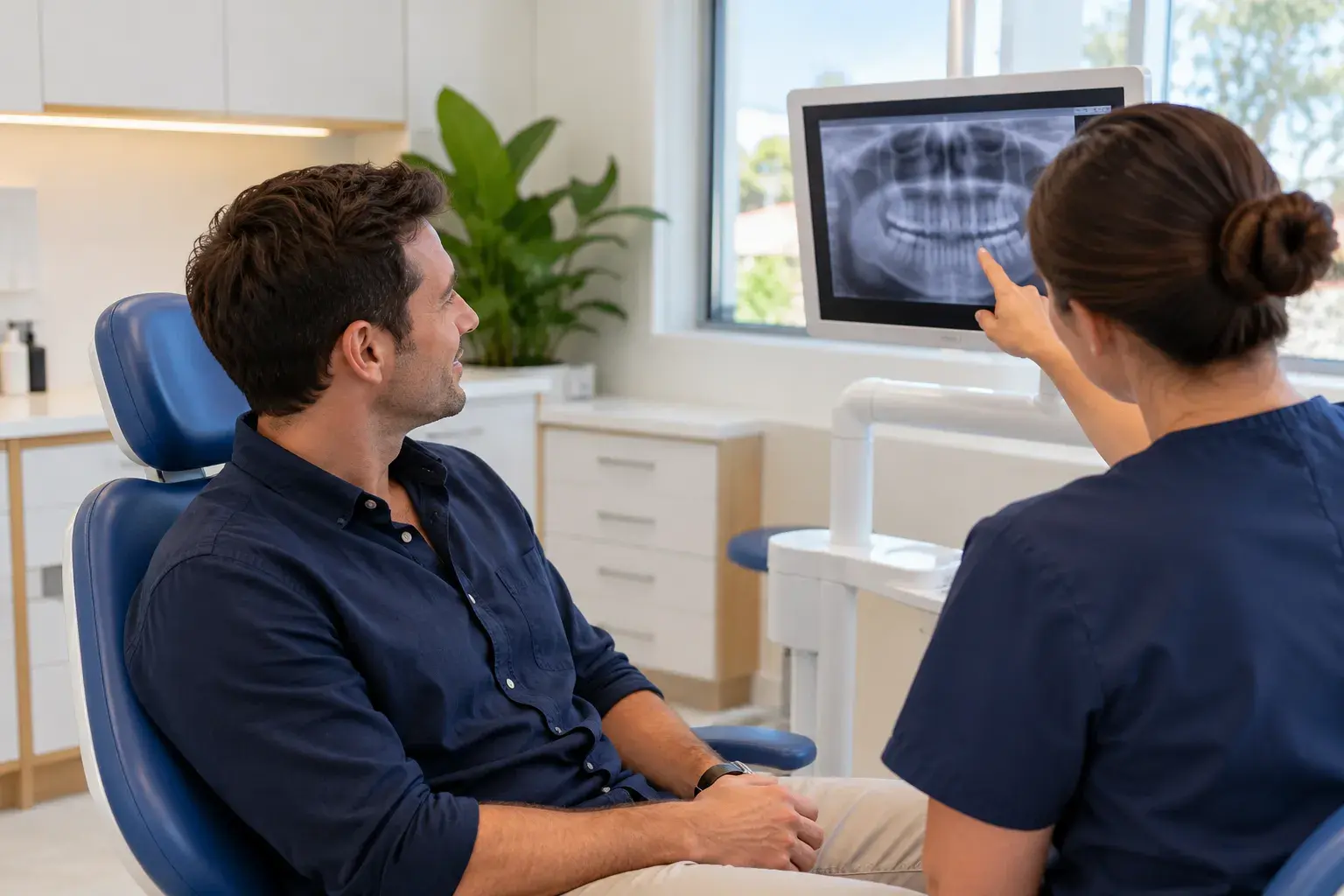
At your visit, your dentist examines the area and takes a digital x‑ray to find the tooth involved and see how far the infection has spread. An OPG x‑ray may be used if the swelling is large or a wisdom tooth is involved. Treatment is done under local anaesthetic, which may need a little more time to work in an inflamed area.
Releasing the pus is often the quickest way to ease pressure and pain. Depending on the situation, this may be done by opening into the tooth to let it drain, or through a small cut in the swollen gum. From there, the main options are:
- Root canal treatment: cleans the infection from inside the tooth so it can be kept, usually over two or three appointments, and is often followed by a crown
- Extraction: removes the tooth and the source of infection, which may be the better choice if the tooth is badly broken down or has a poor outlook
- Gum treatment: deep cleaning of the infected pocket for a periodontal abscess, with ongoing gum care
- Referral to a registered specialist in endodontics or oral surgery for complex teeth or extensive infection
Recovery and what to expect afterwards
Many people notice relief within a day or two of drainage, although the tooth and gum can stay tender for several days. Swelling usually goes down gradually. Rinsing with warm salty water after meals can help keep the area clean, and over‑the‑counter pain relief taken as directed usually manages any soreness.
Like any dental procedure, treatment carries some risks, including post-operative pain, swelling, bruising, a flare‑up of infection, and with extraction, delayed healing or dry socket. Let us know if pain or swelling gets worse instead of better after a few days. Root canal treatment is usually claimed under major dental, while an extraction may fall under general or major dental depending on how complex it is and your policy.
If you’re pregnant, diabetic or have a weakened immune system
Some people are more vulnerable to infections spreading, including those with poorly controlled diabetes, people having chemotherapy or taking immune-suppressing medicines, and anyone with a heart valve condition who has been told to take precautions before dental treatment. If this applies to you, mention it when you call so we can prioritise you appropriately.
Treating a dental infection during pregnancy is generally considered more important than leaving it, and local anaesthetic and low‑dose dental x‑rays can usually be used when needed. Tell us you’re pregnant and how many weeks along you are.
Questions about dental abscess & swelling
The abscess burst and the pain went away. Am I okay now?
Pain often eases once pus drains, but the source of the infection is still there. Without treatment, the abscess is likely to return, sometimes worse than before. Rinse with warm salty water and call us to arrange a visit.
Can a dental abscess go away on its own?
It’s unlikely. The infection may quieten down and drain through a small bump on the gum, but bacteria remain inside the tooth or pocket. Over time this can damage the surrounding bone.
Can I get antibiotics from my GP instead?
A GP may prescribe antibiotics if the infection is spreading, which can be helpful in the short term. You’ll still need a dentist to treat the tooth or gum causing it, so call us as well.
Will you remove my tooth on the day?
Not necessarily. Many abscessed teeth can be saved with root canal treatment, and your dentist will explain the options. Sometimes very large swelling needs to settle a little before definitive treatment.
Why didn’t the local anaesthetic work as well as usual?
Infected, inflamed tissue is more acidic, which can make local anaesthetic less effective. Your dentist may give extra anaesthetic, wait longer for it to work, or use a different technique. Tell us if you can still feel discomfort.
Is a gum boil the same as an abscess?
A gum boil is usually the opening of a drainage channel from an abscess at the root of a tooth. It may come and go and often isn’t painful. It’s still a sign of infection and should be checked.
Can an abscess affect my general health?
In rare cases, a dental infection can spread to other parts of the body and make you seriously unwell. This is why spreading swelling, fever or difficulty swallowing need urgent hospital care.