
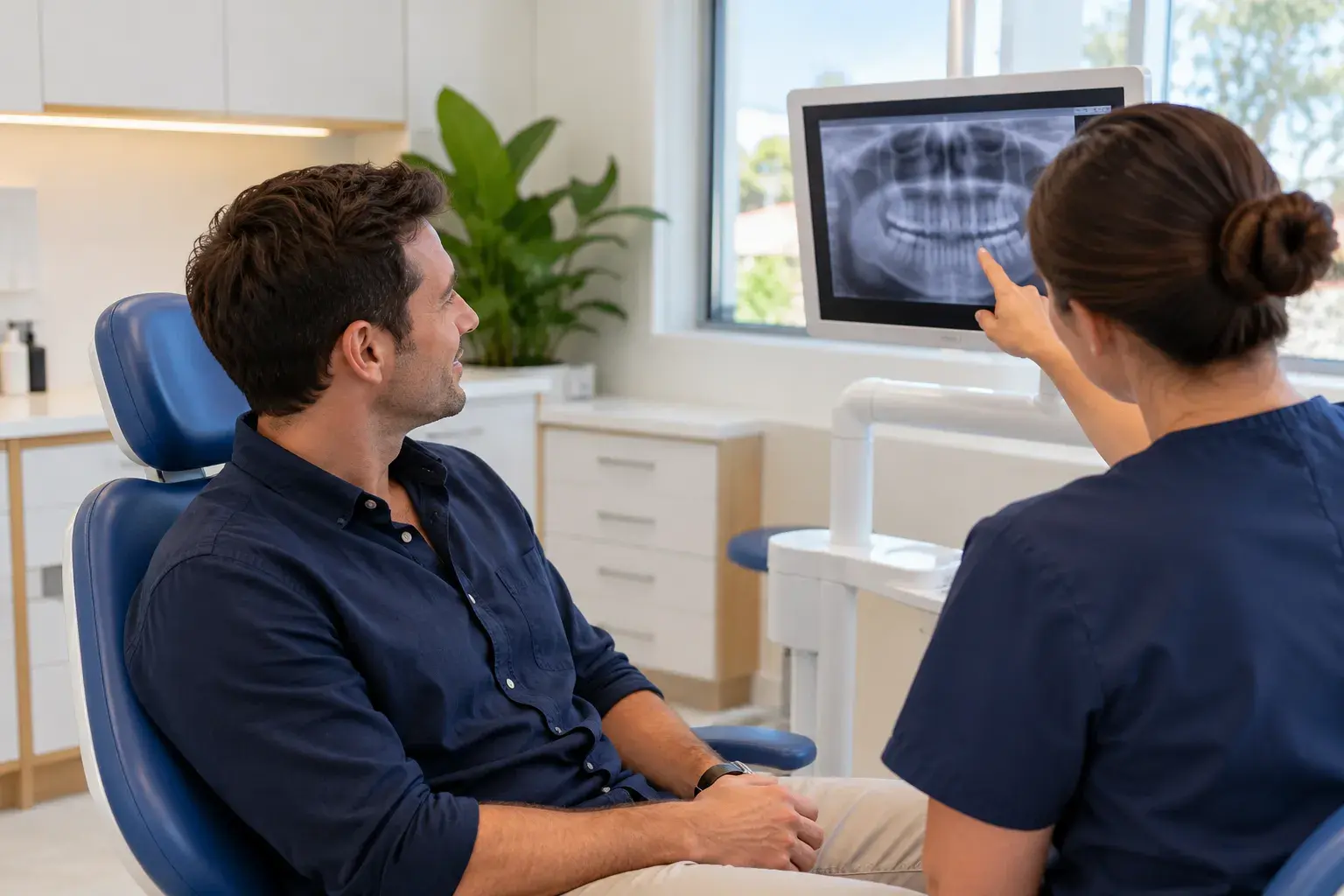
Why wisdom teeth cause trouble
Wisdom teeth are the third molars, the last teeth to form, and they usually try to come through somewhere between about 17 and 25. By then the jaw is often already full, so they may get stuck against the tooth in front, against bone, or under the gum. A tooth caught like this is described as impacted.
Impaction on its own isn’t always a problem. The trouble usually comes from what happens around a partly erupted tooth, where a flap of gum creates a pocket that is very hard to keep clean.
Common problems we see
These are the issues that most often lead someone to ask about their wisdom teeth.
- Pericoronitis: the gum over a part-erupted tooth becomes inflamed or infected, causing pain, swelling, a bad taste and sometimes difficulty opening wide
- Decay in the wisdom tooth itself, which is often too far back to fill well
- Decay or gum damage on the back of the second molar, where food gets trapped against an angled wisdom tooth
- An upper wisdom tooth that has over-erupted and rubs the cheek or lower gum
- Less often, a cyst forming around a buried tooth, usually found on an x‑ray
Ready to book a visit?
When keeping an eye on them is enough
Current Australian guidance generally doesn’t support removing healthy, symptom-free wisdom teeth just in case. If they have come through fully, meet the opposite teeth and can be cleaned, they can often stay for life. The same is true of some deeply buried teeth that sit quietly and show no changes on x‑rays.
In those cases, we simply check them at your regular visits and repeat an x‑ray from time to time. The evidence that wisdom teeth push the front teeth out of line is weak, so worry about crowding alone isn’t usually a reason to remove them.
How we assess them
Small x‑rays rarely show a whole wisdom tooth and its roots, so we take an OPG, a panoramic x‑ray that captures both jaws in one image. It shows how the tooth is angled, how deep it sits, how the roots are shaped and how close they are to the nerve in the lower jaw or the sinus above.
Where the OPG suggests the roots and nerve overlap, a 3D scan can give a clearer picture. We don’t have 3D imaging at the surgery, so we would refer you for that scan if it is needed.
Removal here or by referral
Many upper wisdom teeth, and lower ones that have come through reasonably straight, can be removed at our surgery under local anaesthetic. Some need a small opening in the gum or the tooth divided into sections, and your dentist will tell you in advance if that is expected.
We refer to a registered specialist in oral surgery when a tooth is deeply buried, sits very close to the nerve, or when you would prefer to have treatment while asleep. In some situations a specialist may suggest removing only the crown of the tooth and leaving the roots in place, which can lower the risk to the nerve.
The fee depends on how complex the removal is, and surgical removal of wisdom teeth is often claimed under a different extras item from a simple extraction. If you are referred, the specialist provides their own estimate.
Nerve and sinus risks, explained plainly
Two nerves run near the lower wisdom teeth: one supplies feeling to the lower lip and chin, and the other to the side of the tongue. Removal can occasionally bruise or stretch one of them, causing tingling or numbness afterwards. In most cases this improves over weeks to months, and lasting change is uncommon.
With upper wisdom teeth, the roots can sit close to the sinus, and a small opening between the mouth and sinus can sometimes occur. This often heals on its own with care. Your x‑ray tells us how relevant these risks are for you, and we discuss them before you decide.
Recovery after wisdom teeth
Recovery is usually slower than for a simple extraction, because the tooth is further back and may involve the gum and bone. Swelling commonly builds for two to three days, sometimes with bruising on the cheek and a stiff jaw. A cold pack on the outside of the face for the first day can help.
Plan for soft food and a quieter few days, especially after lower wisdom teeth. The aftercare steps on our extractions page apply here too, and dry socket is more common after lower wisdom teeth, so call us if pain starts building again around day three.
Most people are back to normal eating within about a week, though the socket of a lower wisdom tooth can take several weeks to fill in and may trap food for a while. Your dentist may suggest gently flushing it with warm salt water after the first week to keep it clean.
Teenagers, pregnancy and health conditions
For teenagers, the wisdom teeth are often still forming, and an OPG in the mid to late teens can show whether they are developing with enough room. That gives you time to plan, rather than reacting to a painful flare‑up during exams or a busy year.
If you are pregnant and a wisdom tooth flares up, we focus on easing the infection and pain, and planned removal is usually put off until after the baby arrives unless it can’t wait. If you have a condition that affects healing, or take blood thinners or bone-density medicines, let us know early, as this can affect whether removal is done here or by referral.
Wisdom teeth, step by step
Questions about wisdom teeth
Should I have all four wisdom teeth out at once?
Not necessarily. We usually treat only the teeth causing problems or likely to. If several do need removing, doing them together can mean one recovery, but it depends on the teeth, your preference and whether a specialist is involved.
My gum at the back is swollen and sore. What can I do now?
Warm salt-water rinses, gentle brushing around the area and over‑the‑counter pain relief may help in the short term. If you have swelling in your face, trouble swallowing or a fever, call us promptly, or seek urgent care out of hours.
Is it better to remove wisdom teeth when you are younger?
When removal is needed, it is often easier in the late teens or early twenties, because the roots aren’t fully formed and the bone is softer. That doesn’t mean healthy teeth should come out early. It is a reason to have them checked as they develop.
How much time off work or study should I plan?
After a straightforward upper tooth, many people return to normal activities the next day. After a lower tooth that needed a surgical approach, two or three days of rest is common. Your dentist can give you a better idea once they have seen your x‑ray.
What happens if I leave an impacted wisdom tooth alone?
Many cause no issues at all. Some lead to repeated gum infections or damage to the neighbouring molar over time, which is why we keep checking them. If you notice symptoms, let us know rather than waiting for your next check‑up.
Will I need stitches?
Simple removals often don’t need any. If the gum was opened, a few stitches may be used, and these are usually the dissolving kind. Your dentist will tell you which type you have.