
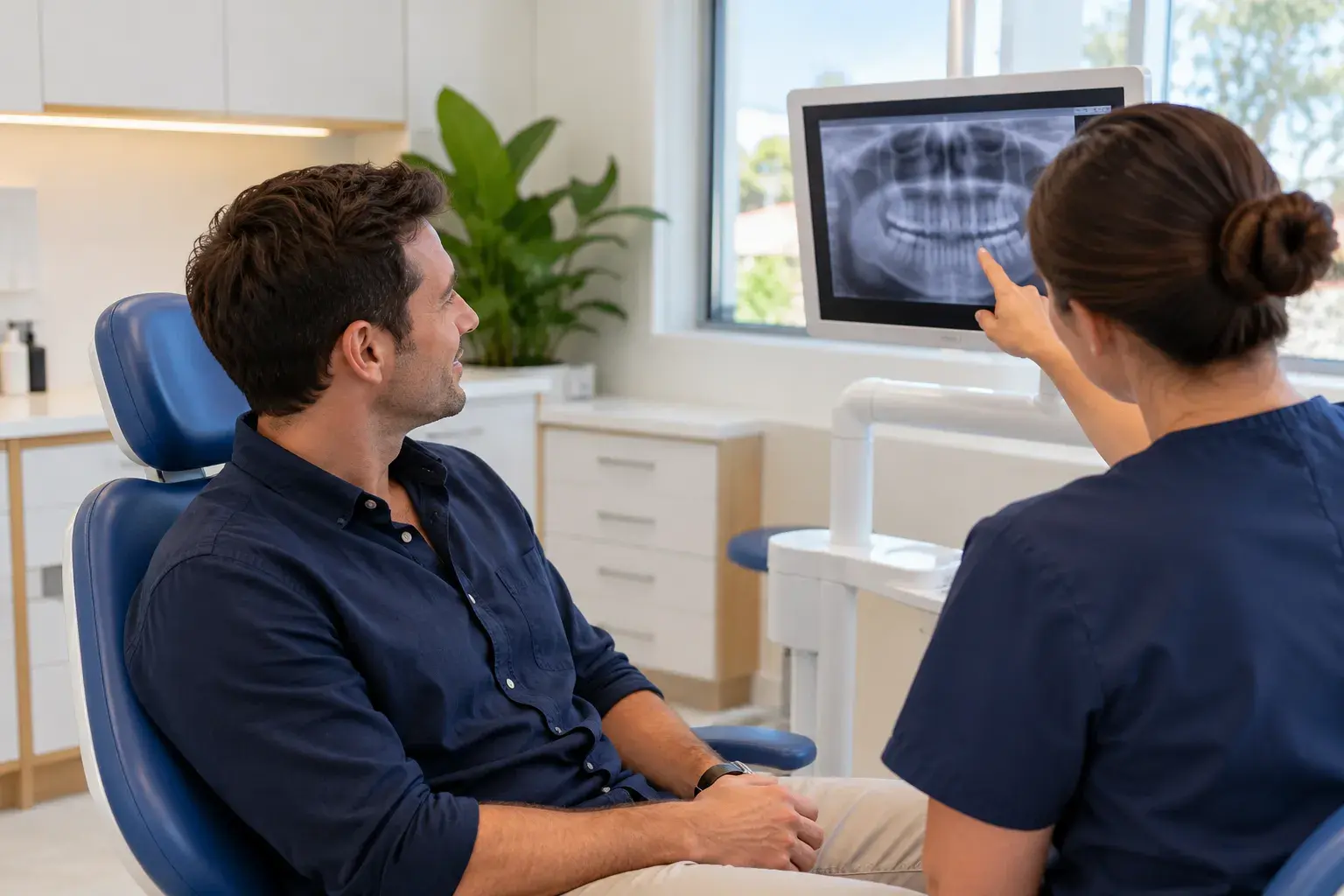
Why the nerve inside a tooth becomes inflamed
Under the enamel and dentine, each tooth has a hollow core holding the pulp, a soft tissue of nerves and blood vessels. The pulp runs from the crown of the tooth down narrow channels in each root, which are the root canals. A front tooth usually has one canal, while molars commonly have three or four.
The pulp sits in a rigid space, so when it becomes inflamed the swelling has nowhere to go. Mild inflammation can sometimes settle once the cause is treated, but if it is severe or bacteria reach the pulp, the tissue usually can’t recover. It may then die and become infected, and the infection can spread beyond the end of the root into the surrounding bone, forming an abscess. Common causes include:
- Deep decay that reaches the pulp
- A crack in the tooth that lets bacteria in
- A knock or injury, sometimes years earlier
- Very deep or repeated fillings in the same tooth
Signs the pulp may be affected, and why some teeth have none
Symptoms vary a lot from person to person. Some people have severe toothache, while others feel nothing at all and the problem is found as a dark area around the root tip on a routine x‑ray. Toothache that suddenly stops doesn’t necessarily mean the tooth has healed, because a nerve that has died can stop sending pain while infection continues.
If you have facial swelling that is spreading quickly, a fever, or any difficulty swallowing or breathing, go to a hospital emergency department straight away. Signs that a tooth may need assessment include:
- Pain with hot or cold that lingers after the drink is gone
- Throbbing pain that starts on its own or wakes you at night
- Tenderness when you bite or tap on the tooth
- A small pimple on the gum that may leak fluid
- Swelling of the gum or face near the tooth
- A tooth that has turned grey or darker than its neighbours
Ready to book a visit?
How the treatment works
The aim is to remove the inflamed or infected pulp, clean bacteria out of the canals and seal them so bacteria can’t return. Fine instruments are used to clean and shape each canal along its length, while disinfecting solutions rinse out debris. Between visits, a medicated dressing is usually left inside the tooth to help settle infection.
Once the canals are clean and the tooth has settled, they are filled with a rubber-like material called gutta-percha and a sealer. A tooth can function well without its pulp, because it is held in place and nourished by the gum, bone and ligament around the root.
Protecting the tooth once the canals are sealed
The temporary filling placed during treatment is not designed to last. If it wears or leaks, bacteria can get back into the canals, so the tooth should be properly restored soon after the root canal treatment is finished.
Back teeth that have had root canal treatment have often lost a lot of structure and are more prone to cracking, so a crown or a cusp-covering onlay is commonly recommended. Front teeth can sometimes be restored with a filling alone. Your dentist will explain what they suggest for your tooth, and that this is a separate step with its own cost.
Success, and the chance of retreatment
Many teeth that have root canal treatment settle and go on to last for many years, especially once they are well restored and kept clean. Outcomes are not certain, though. The chance of success can be affected by how long the infection has been present, how complicated the canals are, whether the tooth has a crack and how well the tooth is sealed afterwards.
Sometimes infection persists or returns, months or even years later. The tooth may then need retreatment, where the root filling is removed and the canals cleaned again, or a surgical procedure at the root tip, usually by a registered specialist in root canal treatment. In some cases a crack is discovered during treatment that means the tooth can’t be saved. Rarely, a fine instrument separates inside a curved canal, and your dentist would explain what that means for the tooth.
Alternatives, including removing the tooth
Once the pulp is infected, the realistic choices are root canal treatment or removing the tooth. Antibiotics alone don’t cure an infected tooth, because they can’t reach bacteria inside a pulp that has lost its blood supply, so they are usually reserved for spreading infection.
Removing the tooth is usually quicker and costs less at the time, but it leaves a gap. You may then choose to replace it with a dental implant, a bridge or a removable partial denture, each with its own cost and treatment, or leave the space and accept that nearby teeth may drift. Leaving an infected tooth untreated is not advised, as the infection can spread.
Referral to an endodontist
Most root canal treatment can be carried out at our surgery in North Beach. Some teeth are more complex, and in those cases your dentist may suggest a referral to an endodontist, a registered specialist in root canal treatment.
Reasons can include canals that are very curved, narrowed or blocked, a tooth that has had root canal treatment before, symptoms that haven’t settled, or the need for surgery at the root tip. If more detail is needed, we may arrange a referral for 3D imaging. We will explain the reasons, send through your x‑rays and notes, and remain your dentist for the rest of your care.
What affects the cost
The fee depends largely on how many canals the tooth has and how many appointments are needed, so a molar usually costs more than a front tooth. The crown or onlay afterwards is a separate item. Many extras policies list root canal treatment under major dental, though some place parts of it under general dental, so it helps to check the item numbers on your estimate.
Root canal treatment, step by step
Questions about root canal treatment
Is the tooth still alive after root canal treatment?
The pulp is removed, so the tooth no longer has a living nerve inside and won’t feel hot or cold. It stays firmly attached and nourished by the gum, bone and ligament around the root, and you still feel pressure through that ligament when you bite.
Does a root-filled tooth need special care?
It is brushed and cleaned like any other tooth, but it can still decay, and without a nerve it won’t warn you with pain. Check‑ups and the occasional x‑ray let your dentist keep an eye on the root and the seal over the years.
Will my tooth change colour after root canal treatment?
Some root-filled teeth, particularly front teeth, gradually darken. A crown covers any change, and for some front teeth internal whitening may be an option your dentist can discuss.
Why is the tooth still tender after the final appointment?
The tissue around the root tip can stay bruised for a few days to a couple of weeks, so biting may feel tender. Pain relief that suits you usually helps. Call us if it gets worse, or if swelling appears.
Can I go back to work after an appointment?
Most people go back to work or their usual activities afterwards. Your lip and cheek may stay numb for a few hours, so take care with hot drinks and chewing until the feeling returns.
Can I have root canal treatment while pregnant?
Dental infection is generally better treated than left during pregnancy, and local anaesthetic is routinely used. Let your dentist know how many weeks along you are, as it helps them decide on x‑rays and timing, and talk to your doctor or midwife if you have concerns.
Can a tooth need root canal treatment twice?
Yes, it can happen. Infection can return if bacteria get back into the canals, for example through a leaking filling or a new crack. Retreatment is sometimes possible, and your dentist may refer you to an endodontist for it.