
What x‑rays show that the eye can’t
Back teeth often touch tightly, so decay can start between them and grow quite large before it’s visible from above. X‑rays can also reveal decay under old fillings and crowns, infection at the tip of a root, bone loss from gum disease, and teeth that haven’t come through yet.
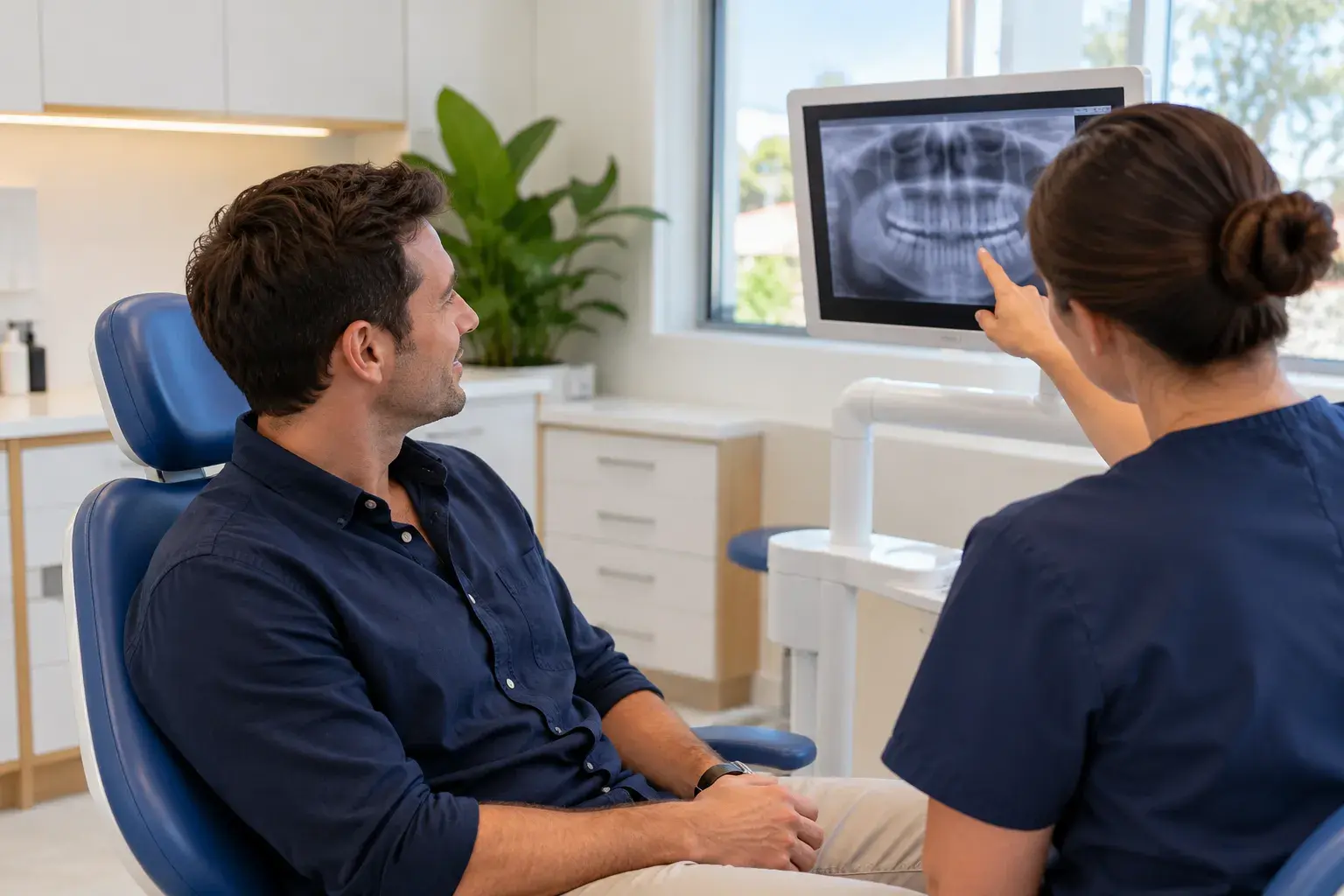
Digital x‑rays use a sensor rather than film, and the image appears on a screen within seconds, with no developing chemicals involved. Your dentist can enlarge it, adjust the contrast and show you exactly what they’re looking at.
Bitewing x‑rays: checking between the back teeth
A bitewing shows the crowns of the upper and lower back teeth on one side in a single image. You bite gently on a small holder, which is where the name comes from. Usually one is taken on each side.
Bitewings are the main tool for finding decay between back teeth and checking whether existing fillings still seal well. They also give a useful view of bone height around the teeth, so they’re often part of a gum assessment. How often you need them depends mainly on your risk of decay. After a run of new cavities, they may be suggested more often until things settle.
Ready to book a visit?
Periapical x‑rays: the whole tooth, root and all
A periapical x‑ray focuses on one or two teeth and shows the full length, from the biting edge down past the tip of the root into the surrounding bone. The sensor is placed further back or higher in the mouth than for a bitewing.
It’s the x‑ray your dentist is likely to take when a particular tooth is aching, swollen or tender to bite on, or after a knock to the mouth. It’s also used before, during and after root canal treatment, before an extraction, and to check bone around a dental implant.
OPG x‑rays: the full picture of both jaws
An OPG (orthopantomogram) is a panoramic image of all the teeth, both jaws, the jaw joints and the lower part of the sinuses. Nothing goes far into your mouth. You stand or sit with your chin on a rest and bite lightly on a small guide while the machine circles your head for several seconds. It doesn’t enclose you, which many people who dislike tight spaces find reassuring.
OPGs are commonly used to check the position of wisdom teeth, follow how children’s adult teeth are developing, plan extractions, dentures or implants, and look for cysts or other changes in the jaw. They show less fine detail between teeth than bitewings, so they don’t always replace them. When a decision needs a three-dimensional view, such as the exact position of a nerve, your dentist may refer you elsewhere for 3D imaging.
Reading your own x‑ray
Dense materials block more x‑rays and look white, while softer or thinner areas look darker. Enamel shows as a bright outer layer, the dentine underneath is slightly greyer, and the nerve space in the centre of each tooth appears as a dark channel running down into the root.
Decay usually shows up as a darker shadow eating into the enamel or dentine, often in a small wedge shape between teeth. Metal fillings and crowns look solid white, while tooth-coloured fillings can look lighter or darker depending on the material. Infection at a root tip may appear as a dark halo in the bone. Your dentist will point these out so you can see what they’re describing.
Radiation dose in context
Everyone in Australia receives a small amount of natural background radiation each year from the ground, the air and even food. As a rough guide, a pair of bitewings is often compared to around a day of that background exposure, and an OPG to a few days. Exact figures vary with the equipment and the person.
Even a low dose shouldn’t be given without a reason. Dentists follow the principle of keeping exposure as low as reasonably achievable: choosing the type of x‑ray that answers the question, taking only the images needed and using recent x‑rays from elsewhere where they’re good enough.
Pregnancy, breastfeeding and children
If you are or might be pregnant, please tell us before any x‑ray. Routine x‑rays are usually postponed until after the baby is born. If you have pain or infection that needs diagnosing, an x‑ray of the mouth may still be appropriate, and your dentist will discuss it with you first. Breastfeeding doesn’t affect dental x‑rays.
Children are more sensitive to radiation than adults, so dentists are more selective with them. At the same time, decay can spread quickly through baby teeth, and bitewings may be suggested once back teeth are touching. An OPG may be useful in mid‑childhood to check that adult teeth are forming and coming through as expected.
How often, and why to bring previous x‑rays
There’s no fixed schedule that suits everyone. Adults with low decay risk and healthy gums may only need bitewings every couple of years or longer, while people with frequent decay or active gum disease may need them more often. Your dentist will explain why a particular x‑ray is due.
If you’ve changed dentists, ask your previous practice to send your recent x‑rays before your first visit. Comparing old and new images shows whether a spot is changing, and it may mean fewer new images are needed.
X‑rays are usually claimed under general dental, with each small x‑ray and an OPG listed as separate items.
Digital & OPG x‑rays, step by step
Questions about digital & OPG x‑rays
Can I say no to x‑rays?
Yes. It’s your choice, and your dentist will explain what they are looking for and what might be missed without the x‑ray. In some situations, such as planning a root canal or extraction, treatment may not be able to go ahead properly without one.
Do I need to take off jewellery for an OPG?
Yes. Earrings, facial piercings, glasses, hair clips, necklaces and removable dentures or plates can show up on the image and hide important detail, so we’ll ask you to remove them first.
Is an OPG the same as a 3D scan?
No. An OPG is a flat panoramic image. A 3D scan, often called a CBCT, shows the teeth and jaw in three dimensions and is used for specific planning questions. If you need one, your dentist will arrange a referral.
I gag easily. Can I still have x‑rays?
Usually, yes. Your dentist can change the sensor’s position, take it quickly and let you pause between images. Breathing slowly through your nose often helps, and sometimes an OPG can provide enough information instead of small x‑rays.
Can I get a copy of my x‑rays?
Yes, you can ask for a copy, for example if you’re seeing a registered specialist or moving away. Let us know where the images need to go and we can usually send them digitally.
Is it okay to have dental x‑rays while breastfeeding?
Yes. Dental x‑rays don’t affect breast milk, and there’s no need to delay feeding afterwards.
Why did my dentist take an x‑ray of only one tooth?
That was most likely a periapical x‑ray. When a single tooth is causing trouble, a focused image of its whole root and the surrounding bone gives more useful detail than a wider view.